
Blog
Best Smart TV 2026: The One That’s Actually Worth Your Money

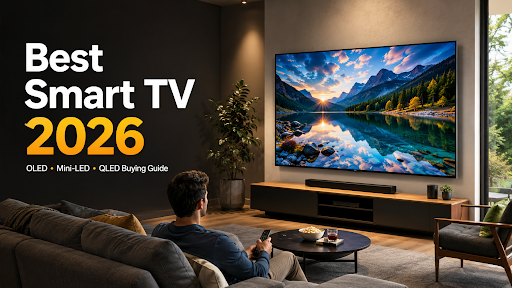
My buddy spent $2400 on an 85-inch TV this spring. The man’s living room is like 12 feet wide, so he had to have known that thing wasn’t fitting right. The sofa is about nine feet from the wall, making him strain to see everything on the screen as if it were a tennis game. He hasn’t had the courage to say this to enough people yet. At the store, no one bothered to inquire about the size of his room, as they were mainly focused on the biggest number that is presented on the box, as that is the easiest way to complete the sale.
That’s the challenge one faces while looking for the best smart TV in 2026. You either go for size and features that you will hardly use or you opt for cheap but have to deal with flat pictures by the end of the second week.
Forget about the spec sheet that no one really cares about. What really matters is the actual room size and budget.
What Actually Matters When You Buy a Smart TV
The dimensions of your television need to be appropriate for the size of your room, not the money you have saved. You should sit approximately 1.5 to 2.5 times the screen’s size away from it, in inches. A 55-inch set requires seating about 7 to 11 feet away from it.
Another factor that should be taken into consideration is brightness. Almost nobody thinks about it until the TV’s already on the wall. A dim TV looks fine in a store aisle with the lights turned low. Put that same TV in your sunny living room at 2pm, and the picture goes flat and gray fast. If your room gets a lot of daylight, brightness beats fancy contrast numbers every time.
Software is the part nobody checks until it’s slow. Roku, Google TV, and whatever Samsung and LG call their platforms this year all work differently. Some are quick. Some make you wait ten seconds just to open Netflix. That doesn’t sound like much until it happens every night for two years.
Best Smart TV 2026 for Small Spaces on a Tight Budget
Small bedroom, dorm room, tiny studio you don’t need a high-end model in a room like that, and honestly you shouldn’t buy one. Grab a TCL or Hisense in the 43- to 50-inch range, 4K, somewhere in the $300–500 zone. It punches above its price. Decent HDR, a smart platform that handles Netflix and YouTube just fine, nothing to complain about.
Don’t chase extra features in a small room. You won’t miss the 120Hz refresh rate. You won’t miss premium sound bar integration either, since your neighbors probably won’t thank you for it. Save the money.
Best Smart TV 2026 for Movie Nights (OLED Picks)
If you watch movies with the lights off, OLED is worth the extra money. Full stop. The pixels turn fully off during black scenes, so you get real black instead of the dark gray you’re used to. Samsung’s OLED lineup and LG’s C-series both test well this year. Rich color, sharp contrast, the kind of thing you notice five minutes into a dark movie and can’t unsee on your old TV.
Expect to pay $1,000 to $1,800 for a 55-inch OLED. Not cheap. But if movie nights are a real thing in your house and not just something you say you do, it’s the one upgrade that’s actually noticeable, not just marketing-noticeable.
Best Smart TV 2026 for Bright Living Rooms
OLED struggles in bright rooms. That’s just true. The visibility of screens is affected by the size of large windows and light from the sun during the day. Mini-LED and QLED units produced by brands such as Samsung, TCL, and Hisense are equipped with very bright displays, which are particularly useful if your room faces west and the combination of sunlight and windows creates a greenhouse effect.
A budget from $900 to $1,400 is appropriate for a 65-inch Mini-LED with brightness, which will be just an idea for a family looking for a big-screen, nice-looking set, even when some curtains are pulled aside.
Best Smart TV 2026 for Gaming
Gamers and movie fans care about different stuff.If gaming’s your thing, you want at least one HDMI 2.1 port, 120Hz refresh, and input lag under 15ms if you can find it listed. Most LG, Samsung, and Sony sets north of $800 handle this fine now it’s stopped being a premium-only feature. Budget models skip it constantly, and it’s easy to miss on a spec sheet since it’s buried in fine print nobody bothers reading until they’re already home, unboxing the thing.
Check for “HDMI 2.1” by name before you buy if gaming is the whole reason you’re upgrading. Skip that check, and you’ll find out mid-match when your screen lags a beat behind your controller and you blame your reflexes for something that was never your fault.
If you want all these picks side by side instead of scrolling back through this whole post, our [full smart TV comparison chart](https://gadgetgridz.com/best-smart-tv-2026-comparison-chart) lays out every option above by size, price, and room type.
Common Mistakes People Make Buying a Smart TV
Buying by screen size alone is the big one. It’s the one that got my coworker, apparently, every time. A huge TV in a small room isn’t a win. It’s just too much screen for your eyes to take in comfortably, and you’ll end up sitting further back than your couch actually allows.
Ignoring the room’s lighting is close behind. An OLED that looks stunning in a dark showroom can look disappointing in your sunlit den, and nobody warns you about that in the store, because store lighting is always dim on purpose.
Skip HDMI 2.1 if you game. Buying a larger screen when a smaller, sharper screen would have been more appropriate. Bigger isn’t automatically better. It’s just bigger, and it’s costing people real money on an annual basis.
OLED vs. Mini-LED: The Quick Version
Everybody asks this eventually. OLED is superior on black levels and contrast, which is important in dark rooms for movies. Mini-LED is superior in terms of brightness, especially in rooms with windows and daylight hours. Price-wise, they’re closer than you’d think at most sizes now, so it really comes down to your room, not your bank account.
Neither one is the “correct” pick. It depends on where the TV lives. Plain and simple.
Frequently Asked Questions
Which is the best smart TV of 2026 suitable for an ordinary living room?
For most ordinary living rooms, especially those with sufficient natural light coming in, a 55- to 65-inch Mini-LED or QLED television will do the job and cost between $900 and $1400.
Will paying for OLED technology be smart in 2026?
Depends on the time of usage. If you are watching at night, then yes. If the room is bright most of the time, though, a mini-LED will perform better and be cheaper as well.
Is a 120Hz refresh rate necessary if you are not going to play video games?
There is no need for the 120Hz refresh rate if you engage in a lot of sport broadcasts or action films. However, if you are using the TV mainly for streaming shows, it does not matter.
How many years can you expect a smart TV to work?
A reasonable expectation is between six and eight years. More often than not, your smart features will quit before the panel stops working.
Is a cheaper off-brand smart TV a bad idea?
Not automatically, and I say that as someone who assumed it would be. TCL and Hisense often use panel tech close to the bigger names, just with a simpler smart platform bolted on. Read real owner reviews, not the star rating, before you decide.
Final Thoughts
No matter what the salesperson might be saying while pointing to the TV, the best smart TV 2026 can provide is not the biggest on the shelf; it’s not the most expensive one either. It’s the one that works for your room, your lighting, and how you actually watch TV, not how you imagine you’ll watch TV someday in some larger home.
My coworker with the 85-inch TV would tell you the same thing now, a year and a lot of neck strain later. He still won’t admit it started with me pointing it out. That’s a different story.
Determine how you want your room to be designed and how you want to use it, then find your TV to fit that, and not the other way around. Before you make a purchase, consult our [full smart TV 2026 picks and pricing guide](https://gadgetgridz.com/smart-tv-2026-picks-and-pricing) to ensure you aren’t sold something that you didn’t intend to purchase.
The ENERGY STAR TV guidelines are a good, independent resource for more information on how brightness and energy use are measured.
