
Blog
Smartphone Comparison Guide: How to Pick the Right Phone

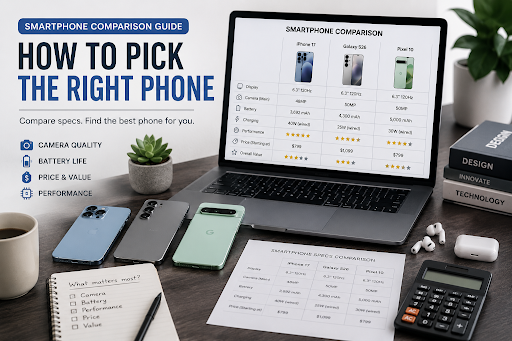
You are in a store holding a phone in each of your hands. The salesperson keeps quoting numbers that have no meaning to you. Bigger battery. Improved camera. More powerful processor. Two hundred dollars cheaper. This situation is familiar to me. Much of that information really doesn’t matter as much as people believe. A true smartphone comparison is not an attempt to find the “best” phone in the world; it is trying to find the right phone for your life.
At GadgetGridz, we discuss phones as we would over dinner with a friend.
Why Spec Sheets Alone Don’t Tell the Full Story
The spec sheet will list 12GB of RAM and a 200-megapixel camera on this phone. That’s great news, but you’ll be left in the dark whether that camera will capture your child’s birthday candle photos in a poorly lit room.
Battery capacity is a good illustration of what I’m talking about here. For example, the Pixel 10 has more battery capacity than the iPhone 17 — 5,000 mAh against 3,700 mAh. But while the Pixel has a better-looking spec, the iPhone charges faster (40W) and uses less power because the chip was designed that way. I’ve seen my Pixel, with its allegedly larger battery, run out of juice before my iPhone with its smaller battery did. That’s the information you’ll find nowhere on the box.
The Three Phones Everyone Is Comparing Right Now
Choosing a new phone in 2026? You’ll be seeing the following models a lot in your research: the Apple iPhone 17, the Samsung Galaxy S26, and the Google Pixel 10. They all have a 6.3-inch screen and a 120Hz refresh rate, which guarantees smooth scrolling. After that, they go their own ways fast.
The iPhone 17 has the sharpest screen of the three, at 460 pixels per inch, and it gets brighter outside too, up to 3,000 nits. Hold the Galaxy S26 next to it, and you’ll feel the difference right away. It’s the lightest and thinnest phone here, and that matters if you carry your phone in a front pocket like I do. The Pixel 10 goes a whole other way and leans into AI, since Google built its Tensor G5 chip just for that.
Price matters too. The iPhone 17 starts around $799. The Pixel 10 starts at about the same price. The Galaxy S26 costs a bit more once you look at the bigger storage options. None of that matters, though, if the phone doesn’t fit your life.That’s the essence of an effective smartphone comparison since you will be able to look at their technical data sheets on GSMArena after figuring out how to identify them.
Camera Comparison: Megapixels Are Not the Whole Story
It is commonly assumed that camera specifications end the entire debate. This isn’t true at all. The iPhone 17 has a 48-megapixel camera. The Pixel 10 has a 50-megapixel camera. The Galaxy S26 uses a 50-megapixel main camera as well.Numbers that close might as well be a tie.
The real difference is in the software. Pixel phones are known for handling skin tones well in different light, and I think that reputation is fair. iPhones tend to win on video, since Apple has spent years making its video recording sharp and smooth. Samsung leans on AI to fix shaky hands or dark rooms after you’ve already taken the shot. So if you mostly shoot video for social media, one phone wins your comparison. Mostly take photos at family dinners? The winner flips.
For those who prefer the figures instead of my observations, DXOMark has independent camera comparisons for the three smartphones.
Battery and Charging: What Actually Matters Day to Day
No one wishes to look for an outlet with just 12 percent of battery left at 4 PM. Here is where numbers come into play. The Galaxy S26 is equipped with a 4,300 mAh battery that charges at 25 W. The Apple iPhone 17 has a slightly lower battery capacity of 3,692 mAh but it charges faster at 40W. The Google Pixel 10 has the largest battery capacity of almost 5,000 mAh and is charged at 30W.
If you charge your phone once and then forget about it overnight, then battery capacity does not really matter. But if you’re the person grabbing ten minutes on the charger before you run out the door, charging speed wins every time no matter what the box says.
Price vs. Value: The Question That Actually Decides Things
Everyone asks which phone is “better.” Wrong question. The genuine one is which telephone offers you the most for your usage. If you never zoom past 2x, the extra megapixels and zoom range of a 200-megapixel zoom lens is just a waste. Paying up for the fastest chip does little if your biggest app is email and a podcast.
That’s the whole idea behind the comparison tools at GadgetGridz—tying the numbers to how you’ll actually use the phone: gaming on the train, photos at a birthday party, work calls, or making it through a travel day on one charge.
How to Run Your Own Smartphone Comparison
You don’t need to be a tech expert to compare phones well. Before you look at a single spec, ask yourself a few things.
Start with what you use your phone for the most. Photos, gaming, work email, and social media all point to different phones being “the winner.” Being honest here saves you regret later. Next, think about how long you keep a phone. You should keep it for four or five years, and in such a case, updates are more important than pure performance. Lastly, take your actual budget into account, not the dream budget. It’s much more reasonable to buy a $600 smartphone that does 90 percent of the work a $1,200 one can do.
Honest answers to these questions will make the process of choosing a smartphone easier, since you’ll be choosing it based on your lifestyle, not the top numbers on some charts. Something else you don’t need to worry about: any mainstream 2026 smartphone will comply with the FCC safety rules.
Making the Final Call
I cannot say that one phone is best for everyone since it’s not. The iPhone 17 is not easily beaten if a seamless video experience with a good connection to the laptop or tablet is needed. The Galaxy S26 is superior if you prefer flexible features, a high-resolution screen, and a stylus that comes with the larger versions of it. If you need AI features and excellent camera pictures, but not at premium prices, get yourself the Pixel 10.
But what if you’d rather see a direct comparison of all three smartphones? Head over to our smartphone comparison tool and check the numbers against what matters to you.
FAQ
Why does charging speed matter?
If you’re the kind of person always running late, a fast charger can save your whole day. Ten minutes on the plug can beat a phone with a slightly bigger battery.
Which phone takes the best photos?
Depends what you’re shooting. Pixel does great with skin tones. iPhone wins on video. Samsung is good at saving shaky or dark shots.
Does screen brightness matter?
Yes, especially outside. Ever try reading your phone at the beach? A brighter screen makes a real difference.
Is video quality the same as photo quality?
Not always. Some phones nail photos but are just okay at video, or the other way around. Worth checking both if you care.
What is the easiest way to pick a phone?
Think about your day, not the spec sheet. Whatever you do most, texting, gaming, taking pictures of your kids, pick the phone that’s best at that.
