
Blog
Gaming Headset Review 2026: What Actually Matters Before You Buy

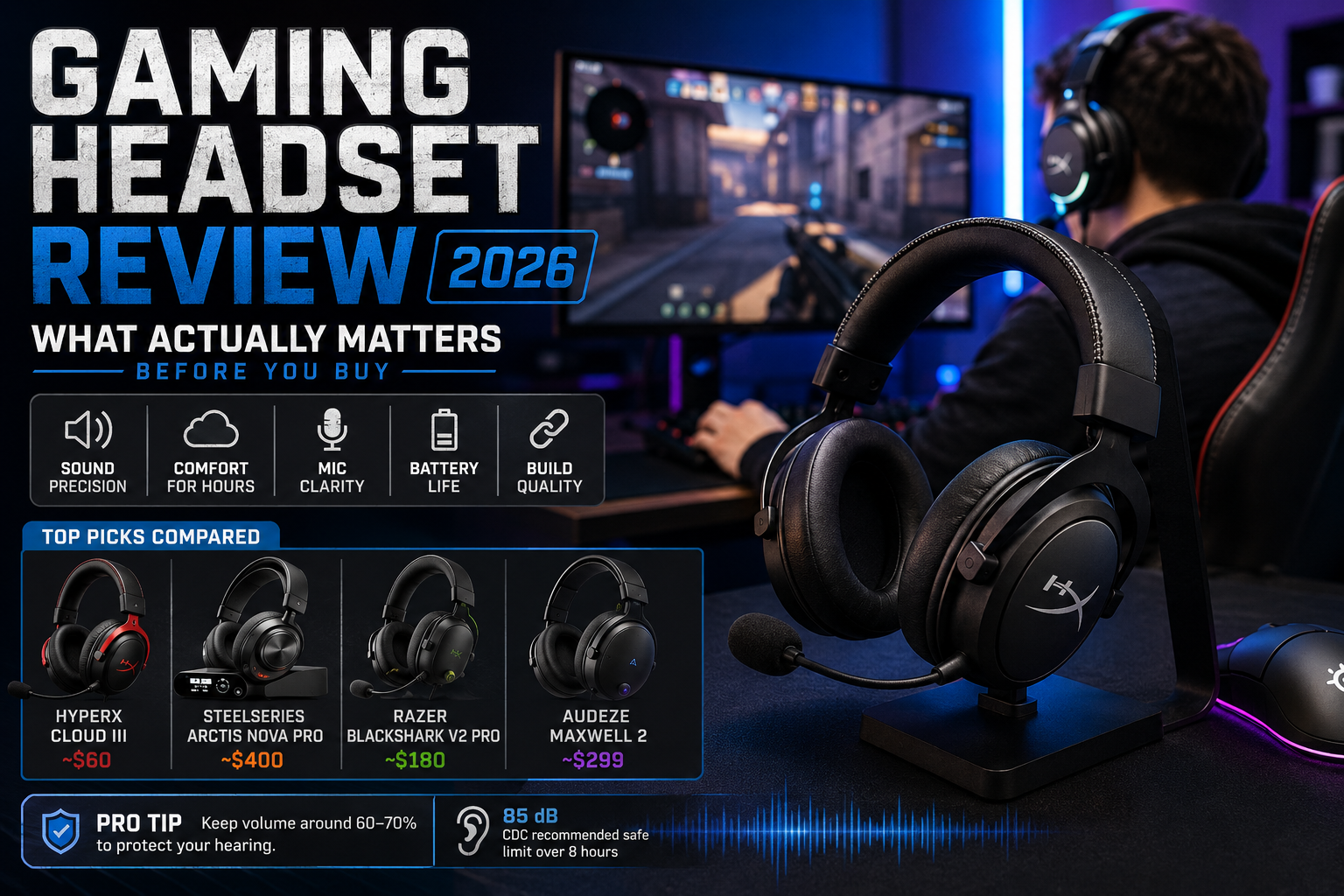
You’ve probably scrolled through ten different gaming headset review roundups already and still can’t tell which one’s worth your money. Half of them read like ad copy. And no spec sheet is going to warn you that a headset turns into a vice on your skull two hours into a ranked match, because nobody puts that in the marketing.
So skip the specs-only approach. This is what those numbers actually feel like once you’re wearing the thing mid-session, not what they look like printed on a box.
What Actually Makes a Headset Good
Sound quality gets most of the attention, for good reason. With a wider frequency range, you catch small footsteps behind you in an FPS that cheaper drivers just flatten out or miss entirely. But sound alone doesn’t make something a good gaming headset. Comfort matters just as much. Arguably more, if you’re the type who plays for four hours and forgets to get up.
Weight, clamp pressure, and ear cushion material these three quietly decide whether a headset survives a long session. Memory foam under breathable fabric holds up way better than leatherette once you’re two hours in and sweating a little. A headset that sounds incredible but pinches your head after ninety minutes isn’t a good gaming headset. It’s a good pair of headphones you’re going to stop wearing.
Mic quality is the one people forget about until it burns them. Built-in gaming headsets will not be as good as a cheap USB microphone. If at all there is any chance that you might want to stream someday, you should budget for a mic rather than rely on the headset.
Wired vs. Wireless: The Real Tradeoff
Wireless got good enough a while back that latency stopped being the actual issue. A modern 2.4GHz connection runs under 2 milliseconds of delay, which you will not feel during play. Bluetooth’s still behind on that front, so skip it for anything competitive.
The real tradeoff with wireless is battery anxiety, one more device competing for a charger. Wired sidesteps that completely. Zero latency, no charging schedule, no dongle disappearing into a drawer somewhere, and it’s usually cheaper for comparable sound. If you’re on a budget, or you’re sick of things fighting over your last USB-C port, wired isn’t settling. It’s just a different set of tradeoffs, and for a lot of people it’s the smarter one.
What the Top Picks Get Right (and Wrong)
- HyperX Cloud III, around $60. Nothing flashy about it the app is barebones, and the spatial audio doesn’t touch pricier competitors. But it’s held up in long-term reviews, it’s comfortable, and the mic is clear enough for actual voice chat. That covers what most people need. Nothing extra, but nothing missing either.
- SteelSeries Arctis Nova Pro runs closer to $400, and it earns that number with one genuinely clever trick—a base station with hot-swappable batteries, so one charges while you’re using the other. Battery anxiety just goes away. That said, if you’re not gaming for hours a day across multiple systems, you’re paying for a problem you don’t have.
- Razer BlackShark V2 Pro sits in the middle. Usually the safer wireless pick if you don’t want to pay for features you’ll never touch. Strong mic. The battery lasts. Comfortable enough that I’d trust it for a long session without second-guessing it.
- Audeze Maxwell 2, for when sound quality beats out everything else, weight and price included. It runs planar magnetic drivers most gaming headsets can’t touch. Heavier and pricier, and the separation between layers of audio is a real jump you’ll notice in the first five minutes.
There’s no single winner in this group, and there probably shouldn’t be. These four are solving different problems.
A Quick Note on Volume and Your Ears
Long sessions make it easy to creep the volume up without noticing, especially during something explosion-heavy. The CDC’s National Institute for Occupational Safety and Health sets a recommended safe exposure limit of 85 decibels averaged over eight hours, and plenty of headsets can blow past that well before hitting max volume. Staying around 60 to 70 percent of max during long sessions protects your hearing without really costing you any immersion.
How to Actually Decide
Get a headset that matches how you actually game, not how you think you’ll game. The amount of comfort design required for two hours of casual play isn’t necessary for four hours of habitual play. Competitive shooting games benefit from positional audio more than a tuning designed for bass-heavy music. If you have a good microphone that works or you intend to buy one, save some money on the microphone of the gaming headset itself and invest it in better drivers.
Consider the return policy before you purchase. Comfort is very personal, and a headset that felt comfortable to wear for five minutes in a store demonstration can feel entirely different after just two actual play sessions.
The Bottom Line
The best gaming headset review will always be your own, conducted with a headset worn in actual use rather than an unboxing video. Match the selection based on your needs: a wired one if you prefer simplicity and budgeting, a wireless one if freedom of movement is your primary concern, and headphones with planar magnetic drivers if sound quality comes first. For more hands-on tech reviews and buying guides, check out Gadget Gridz’s gaming category or browse the latest reviews on the blog.
FAQ
What should I look for in a gaming headset review?
Comfort over long sessions and mic clarity matter more day to day than the frequency range printed on the box. Directional audio accuracy is the other one worth checking.
Is wireless or wired better for gaming?
Honestly, wired wins for me unless you specifically need to walk around. Latency on wireless is fine now, but you’re still charging the thing, pairing it again after a firmware update, all that. Wired, you just plug in and forget about it.
What’s the best budget gaming headset?
HyperX Cloud III, around $60. It keeps showing up as the value pick because the comfort and mic clarity hold up at that price.
Do expensive gaming headsets actually sound better?
Often, yeah. Planar magnetic drivers instead of the cheap dynamic ones you can usually hear the difference in, more detail and tighter bass.
How loud is too loud for gaming headsets?
The CDC says 85 decibels average over eight hours is the line before you’re risking your hearing. I don’t sit there measuring decibels, though; just keep it around 60-70% of max on long sessions, and you’re probably fine.
